
Universal Questions: Where Did I Come From?

Where did I come from?

A question of origin.

Every person will ask this question at some point in their life. Every significant worldview has an answer to this question. This is the existential question.

Answers to this question are numerous and they range from random chance to God and everything in between.

Fortunately, the Bible answers this question clearly and completely.

 Then God said, “Let us make mankind in our image, in our likeness…”
 So God created mankind in his own image,
    in the image of God he created them;
    male and female he created them.

Genesis 1: 26a-27

Notice the use of “us” and “our”. The creation account includes God, Jesus, and the Holy Spirit. This makes sense when you consider the following-

The Son is the image of the invisible God, the firstborn over all creation. For in him all things were created: things in heaven and on earth, visible and invisible, whether thrones or powers or rulers or authorities; all things have been created through him and for him.

Colossians 1:15-16
The importance of origin cannot be understated. This is why I chose to address this question first, because our view of origin determines our view of the other Universal Questions. 
This point will be made more clearly when I address the next question “Why am I here?”
Universal Questions: Introduction

The human experience is different for all of us, but the same in many ways. At the most basic levels, the human experience is the same for everyone.

We are born. We live. We die.

We face these same realities regardless of our worldview.
It makes no difference if you are a Christian, Muslim, atheist, etc.

Within this experience, there are questions that we must address.
Questions that everyone asks at some point.
Questions that worldviews seek to answer.

Universal Questions.

My next few entries will take a look at these questions through the lens of a Biblical worldview.

(Briefly, a Biblical worldview stems from a belief that the Bible is the infallible Word of God and it serves as the foundation for your interaction with the World)

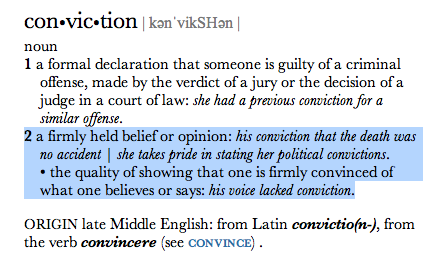
Convictions

The New Year has rolled around and we are already into February of 2013. Where does the time go?

I sit here and write this as a break from studying. This topic has been on my mind for months now, but now seems like a good time to finally flesh it out with words.

As a Christian, is it important to have convictions? 

“Firmly held beliefs or opinions”

I ponder this question and I wonder if convictions even exist in a society that increasingly denies the existence of absolute truth.
You see, convictions require you to take a stand. They require you to draw a line in the sand.
As a Christian, taking a stand is becoming increasingly difficult. You are marginalized and called a bigot or charged with hate speech.

Hate speech? For simply stating what the Bible says? (Matthew 10:22)

Unfortunately, we (as the Church) have started to  yield to these charges.
Society has permeated the Church as opposed to the Church permeating society. (Matthew 5:13-16)

Denying Biblical truth raises some serious questions
If we are not standing on Biblical truth, then what are we standing on?
If we deny the absolute truth of the Bible, then what does that mean for the person of Jesus Christ?
If Genesis is bogus, and the Old Testament is bologna, then why even believe in Jesus Christ?

I say all of that to say this-

Convictions are very important.

 As Christians, our convictions should be based on Biblical truth.
I encourage you to investigate your convictions. Be honest with yourself and compare your deeply held beliefs to what Scripture has to say.

– B

Tug-of-War

Tug-of-War
A game that pretty much everyone has played. (If you went to Elementary school in America, then you played Tug-of-War)

You are familiar with this competition. Groups stand on each side of the rope and tug their hearts out in hopes of pulling the other group beyond a certain point. More exciting variations include sand, mud, or water in the middle.

Think back to how it felt.. You would grab the rope and begin pulling. Time would go by and you would begin to sense victory or defeat. You would pull harder and harder until you reached the breaking point. The breaking point is when you knew the outcome: victory or defeat.

I reached the conclusion yesterday that the Christian walk is similar to Tug-of-War in many ways. Just think about it- Spirit vs Flesh. A constant struggle that all of us face.

The Bible clearly explains the relationship. They are at war.

For the flesh desires what is contrary to the Spirit, and the Spirit what is contrary to the flesh. They are in conflict with each other, so that you are not to do whatever you want.
Galatians 5:17
There is one HUGE difference between Tug-of-War and the Christian walk.. And that is the outcome. 
Losing in Tug-of-War is not a desirable outcome. Losing in the Christian walk is… Surrender. 

You see, naturally we think that we are on the side of the Spirit. But that is not the case. Our flesh and sin nature come naturally to us, and we will fight against the Spirit with every ounce of energy in our soul. 
For us it is impossible to “lose” because we live victorious thru Christ. I’ve read Revelation, and if you have placed  your hope in Christ then you know that the outcome is pretty good for us. 


So what is the problem?
Surrender. 
Letting go of the rope. This is contrary to our nature. 
Surrender is terrifying, which is why I suspect we fight so much. 

I can’t tell you how to surrender completely. I struggle with this as well. All I can say is that true surrender is the only way that we can truly walk with Christ as He intends.

The Reality of Morality

 For although they knew God, they neither glorified him as God nor gave thanks to him, but their thinking became futile and their foolish hearts were darkened… They exchanged the truth about God for a lie, and worshiped and served created things rather than the Creator—who is forever praised. Amen.

Romans 1:21&25

I will attempt to keep this short and to the point:

Morality does exist.

I know this is not a radical statement. Many people would agree with it. Obviously people disagree on where morality comes from, but only a minority deny the existence of morality.

At least explicitly deny the existence of morality. These people usually ascribe to some form of Moral Relativism.

(Moral Relativism is a philosophy that essentially states that morality is situational, based on the individual, denying the existence of moral absolutes etc.)

This philosophy has many critics, and rightfully so. I am not going to spend time defeating the philosophy, I just recommend you do some research on your own if you are interested.

I have made an observation that troubles me- Many Christians ascribe to a form of Moral Relativism. Maybe not explicitly, but implicitly.

Consider these statements that I have heard or read in the last year:

“The Bible and the theory of Evolution can co-exist”
“I am against abortion, except in cases of rape and incest”
“It is not the governments responsibility to enforce morality”
“Although I am against homosexuality, it is not my place to prevent homosexual couples from getting married.”

(And I can already hear you preparing to call me a hypocrite, and thats fine because I am.)

Now hear me out. I know I touched on some of the most controversial issues of our day. I probably struck some nerves. I get that, be mad at me.

But listen, here is the issue I have with all of those statements-
They deny the truth of the Word of God.
And why is this important?
Not because of politics
Not because of society
Not because of equal rights
Not for any of those reasons.

This is important because when you deny the truth of the Word of God, then you effectively bring into question the truth of the resurrection of Jesus Christ, the very foundation of our Faith. 

Do you see the connection? Do you see why this is so important?!

If parts of the Bible can be discarded, or regarded as untrue.. Then the implications of this are huge. You can completely undermine the Christian faith!

I encourage you to ask this question: Have I exchanged the truth of God for a lie?